
I once helped my cousin Priya move into a dorm that was roughly the size of a walk-in closet with a window, and we hauled up eleven bags, a floor lamp, and a rolling cart she had been “saving for this exact moment.” By hour two, her roommate’s parents were politely stepping over a laundry basket to reach the bed.
By week three, half of that stuff was back in her car. The dorm room packing list she had copied from a big-box store flyer had very little to do with the room she actually got.
If you are figuring out what to pack for a dorm room right now, here’s the thing: most freshman packing mistakes are not about forgetting something. They are about bringing the wrong version of something, or way too much of it.
I’ve watched this play out with friends, with my younger sister, and in a lot of reader emails, and the same dozen errors show up every August.
Below is what freshmen get wrong when packing for their dorm room, why it matters, and what I’d do differently. If you want the decorating side of things after you’ve sorted your packing, my guide to dorm room decorating ideas picks up where this one leaves off.
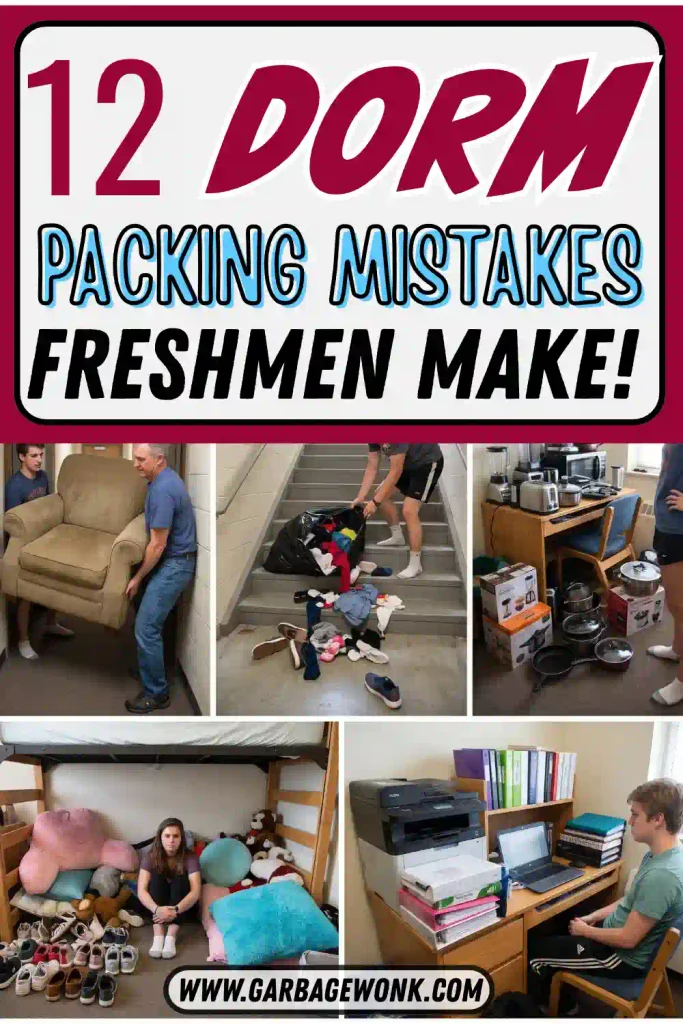
Mistake 1: Packing Your Whole Closet Instead of One Season
A standard dorm closet or wardrobe is often under three feet wide, and your roommate is sharing the same footprint.
Overpacking clothes is the number one thing that turns a dorm room into a storage unit, because clothing is the only category that quietly expands to fill whatever space exists.
Pack for the first six to eight weeks of weather, plus one outfit for something nicer (a presentation, a club interview, a surprise date).
Then do the swap during fall break or over Thanksgiving. I tell everyone the same rule: if you have not worn it in the last month at home, it is not coming. I made the mistake of bringing four winter coats to a September move-in once, and I still think about the hanger space they ate.
Pro tip: Vacuum-seal bags are great for off-season storage under the bed, but do not seal anything you’ll need in the first month. Sealed bags are a pain to reopen and re-compress in a tiny room.
Mistake 2: Buying Standard Twin Sheets When You Need Twin XL
Most college dorm beds are twin XL, which is 38 by 80 inches instead of 38 by 75. Standard twin fitted sheets will pop off the corners by the second night, and honestly nothing makes a first week feel more chaotic than re-making a bed at 1 a.m. because the sheet keeps sliding.
Check your school’s housing page before you buy anything. Some schools have full-size beds, some have adjustable bed heights, and a few older buildings have odd mattress sizes. Measure the mattress thickness too.
Many dorm mattresses are only 5 to 6 inches thick, but if you add a 3-inch topper you’ll need deep-pocket sheets, and I’d go with a 15 inch pocket to be safe.
If your school offers a lofted bed, that changes your storage math significantly. I wrote up what actually works in dorm room ideas for lofted beds, including what not to hang from the frame.
Mistake 3: Skipping the Mattress Topper
Dorm mattresses are usually vinyl-covered and firm in a way that feels like sleeping on a gym mat. A lot of freshmen skip a topper to save money, then spend the first semester wondering why they’re tired and sore.
A 2 to 3 inch memory foam topper typically runs $40 to $90, and it’s the single purchase I’d call worth it for sleep quality.
Skip the very thick ones (4 inches and up) unless you have a lofted bed with plenty of rail height, because a tall topper on a tall bed can put you uncomfortably close to the ceiling or leave you with almost no guardrail.
Mistake 4: Buying Storage Before You’ve Measured the Room
This is the classic. Someone buys a six-drawer rolling cart, a hanging shelf organizer, and an under-bed bin set, and then finds out the bed risers are fixed at a height that makes the bins useless.
Dorm storage ideas that look great in a store photo often fail in a real room because dorm furniture is built-in, awkward, and different from school to school.
Get the dimensions of everything: the desk, the closet opening, the distance under the bed, and the space between the bed and the window.
Many schools publish a room layout PDF. I keep a little note on my phone with those numbers for every space I’m planning, and it has saved me from at least three returns.
If you want a sense of how easy it is to make the wrong call in a small footprint, the common small apartment decorating mistakes I covered translate almost one to one to dorm rooms.
| Storage Type | Best For | Typical Cost | Watch Out For |
|---|---|---|---|
| Under-bed bins with wheels | Off-season clothes, shoes | $20 to $45 | Bed clearance under 6 inches |
| Hanging closet shelves | Sweaters, jeans, small items | $15 to $30 | Weak fabric that sags when full |
| Rolling cart (3 to 4 tier) | Toiletries, snacks, desk supplies | $25 to $60 | Eats floor space fast in shared rooms |
| Over-the-door organizer | Shoes, cleaning supplies | $12 to $25 | Door thickness and hook fit |
| Bed risers | Adding 6 to 10 inches of storage | $20 to $40 | Some schools prohibit them |
Mistake 5: Not Texting Your Roommate Before Buying Anything
Two mini fridges, two microwaves, two rugs, two full-size mirrors. It happens every year, and it’s one of the biggest wastes of money in the whole college packing list. The room is small enough that duplicating big items means one of you ends up returning, storing, or hiding something.
Make a simple shared note with three columns: what I’m bringing, what you’re bringing, and what we’ll buy together. The shared items are usually a fridge, a microwave, a rug, and a small trash can.
Agree on a rough color palette too so the room does not look like two different people moved into two different rooms. I broke down how to do that in dorm room color scheme ideas, and it works even if you and your roommate have wildly different taste.
Pro tip: Whoever brings the fridge should check capacity limits on the housing site. Many schools cap mini fridges at 4.4 cubic feet or around 3.1 cubic feet if there is a microwave in the same outlet circuit.
Mistake 6: Bringing Appliances and Decor That Violate Dorm Rules
Every year, freshmen show up with candles, string lights wired to the ceiling, air fryers, toaster ovens, and halogen lamps, and every year some of it is confiscated at the first room inspection.
Housing rules exist because of fire code, not because someone wants to ruin your vibe.
Read the prohibited items list before you shop, not after. Common bans include open-coil heaters, multi-cup coffee makers with exposed heating elements, wax warmers, and anything with an open flame.
Battery-operated flameless candles are almost always allowed, and LED string lights are usually fine as long as you are hanging them with approved damage-free hooks instead of nails.
A friend of mine, Danielle, lost a $60 rice cooker to a resident advisor in week one because her building only allowed appliances with automatic shutoff. It had one, but she could not prove it, so out it went. Keep the manuals or take a photo of the label.
Mistake 7: Underestimating How Many Outlets You’ll Actually Need
Most dorm rooms have two to four outlets per room, and they are never where you want them. By October you’ll have a laptop, phone charger, lamp, fan, and probably a mini fridge all fighting over the same wall.
A surge protector power strip with USB ports and a 6 to 10 foot cord is a better buy than a basic extension cord, and make sure it is UL listed because many schools only allow those. Do not daisy-chain power strips, which is an instant fire hazard and a quick way to get written up.
If your bed is lofted, a longer cord (or a clip-on power strip that mounts to the frame) saves you from reaching under the bed all night. Cable clips and an adhesive cord organizer, around $8 for a pack, make a bigger visual difference than you would expect.
Mistake 8: Forgetting the Practical Bathroom Stuff
Shared bathrooms are the part nobody really prepares for. Freshmen pack cute decor and forget a shower caddy, shower shoes, a quick-dry towel, and a hook for the bathroom stall door.
I’d buy a mesh shower caddy that drains and a pair of flip-flops you actively do not care about, plus a dedicated bag to carry everything back to your room so you aren’t leaving your products in the hall.
A microfiber towel dries much faster than a thick cotton one, which matters when your room has no real place to air out a wet towel.
Also pack a small tote with a basic first aid kit, pain reliever, cold medicine, and a thermometer. The first time you get sick at 11 p.m. in a building with no pharmacy open, you’ll understand why.
Mistake 9: Packing a Huge Supply of Things You Can Buy There
Bulk toiletries, a year of school supplies, and a giant pantry haul all seem smart until you realize you’re carrying them up three flights.
Anything bulky, cheap, and sold within a mile of campus should be bought after you arrive.
Pack a one to two week supply of toiletries and cleaning supplies. Buy school supplies only after you’ve seen your syllabi, because a lot of professors say no binders, no notebooks, or laptop only.
I’ve seen a freshman unpack 14 composition notebooks for a semester where she used two.
| Bring From Home | Buy After You Arrive | Leave Home |
|---|---|---|
| Bedding, topper, pillows | Trash can, cleaning supplies | Extra winter coats |
| Laptop, chargers, surge protector | School supplies, notebooks | Full-size appliances |
| Shower caddy, flip-flops, towels | Groceries, snacks, water bottle refills | Candles, extension cords |
| Meds, first aid, key documents | Room fan, if needed | Every pair of shoes you own |
Mistake 10: Skipping Laundry Planning
Laundry will be the most underestimated part of your first semester. Dorm laundry rooms are crowded, machines break, and some run on an app or a card that you have to load with money in advance.
Bring a hamper with straps or a rolling laundry bag, because carrying a basket down a stairwell is its own workout.
Pack a small supply of pods or sheets rather than a jumbo jug, and a mesh bag for delicates. Budget roughly $2 to $4 per wash and dry combo at most schools.
If you can pick the time, do laundry on a weekday morning. Sunday night is a war zone, and I’ve personally waited 45 minutes for a washer on the first Sunday of a semester.
Mistake 11: Ignoring Comfort and Warmth for Cold Months
A lot of freshmen pack as if it will be summer forever, and then are blindsided by drafty windows and unpredictable heating. Dorm radiators are either a sauna or a freezer, with very little in between.
A lightweight throw blanket, thick socks, a hot water bottle, and an extra comforter that lives in a bin under the bed are worth the space. If your window leaks, removable weatherstrip tape, around $10, makes a noticeable difference.
For a few more ideas on making a small space feel warm, my post on cozy small apartment ideas for winter has easy swaps that work just as well in a dorm.
Pro tip: Warm light matters more than extra blankets. Swap harsh overhead bulbs or the default desk lamp for a 2700K warm white bulb and the whole room feels about ten degrees cozier.
Mistake 12: Treating Decor as an Afterthought (or the Only Thing)
This goes both ways. Some freshmen pack zero decor and spend a semester in a bare cinderblock box. Others pack so much decor that there’s no room for the things they use every day.
My rule is the 80/20 approach: 80 percent of what you bring should be functional and 20 percent should make the room feel like yours.
A single tapestry or a few framed photos with damage-free strips, one good lamp, and a rug that covers most of the floor will do more than twenty small knick-knacks. Hold back a couple of items and decide what the room needs after you’ve lived in it for a week.
How Much Does a Dorm Packing Budget Really Cost?
If you buy everything new, a realistic budget for a basic college dorm checklist is about $300 to $500. That covers bedding, a topper, a surge protector, storage, a shower caddy, a lamp, and a few decor basics.
You can bring that down to around $150 to $250 by borrowing from family, buying a few things secondhand, and splitting shared items with your roommate.
If you’re allocating limited cash, I’d put it toward sleep first (sheets and topper), then power and lighting, then storage, and decor last.
Everything else can wait for a good sale or a Facebook Marketplace run once you are on campus, where outgoing seniors sell fridges and rugs cheap every May.
If I Were Packing for Freshman Year Again
I’d start with half of what I thought I needed, and I’d text my roommate first. I’d buy the right-size sheets, a decent topper, a surge protector, and a good lamp, and I’d leave the shopping cart for week two.
The room you actually get is almost never the room you pictured, and the best dorm room packing list is the one you adjust after you’ve seen the space. Pack lighter than feels natural, and let the room tell you what’s missing.
Frequently Asked Questions
What should I pack for a dorm room first?
Start with bedding sized for a twin XL mattress, a topper, a surge protector, toiletries and a shower caddy, medications, your laptop and chargers, and key documents. Those are the items that affect sleep, safety, and basic function in the first week.
How early should I start packing for college?
Start about four to six weeks before move-in, but only buy big items after you’ve heard from your roommate and read your school’s housing list. Packing can start early, shopping should not.
What should freshmen not bring to a dorm?
Skip candles, extension cords, most cooking appliances, halogen lamps, too many shoes, and duplicates of shared items like fridges and microwaves. Always check your school’s prohibited items list first, since rules vary a lot.
Do I need a mini fridge in my dorm?
Not always. Many dorms offer shared kitchens or rental fridges, and splitting one with your roommate is cheaper. If you do buy one, check the size limits before you purchase.
How much should I spend on dorm essentials?
Most students spend between $150 and $500 depending on what they already own. Prioritize sleep, power, and storage before decor, and buy bulky or cheap items after you arrive.
Can I use nails or adhesive on dorm walls?
Nails are almost always prohibited. Damage-free hooks and strips are typically allowed, but ask your housing office and test in a hidden spot before committing to a whole wall of frames.


Leave a Reply